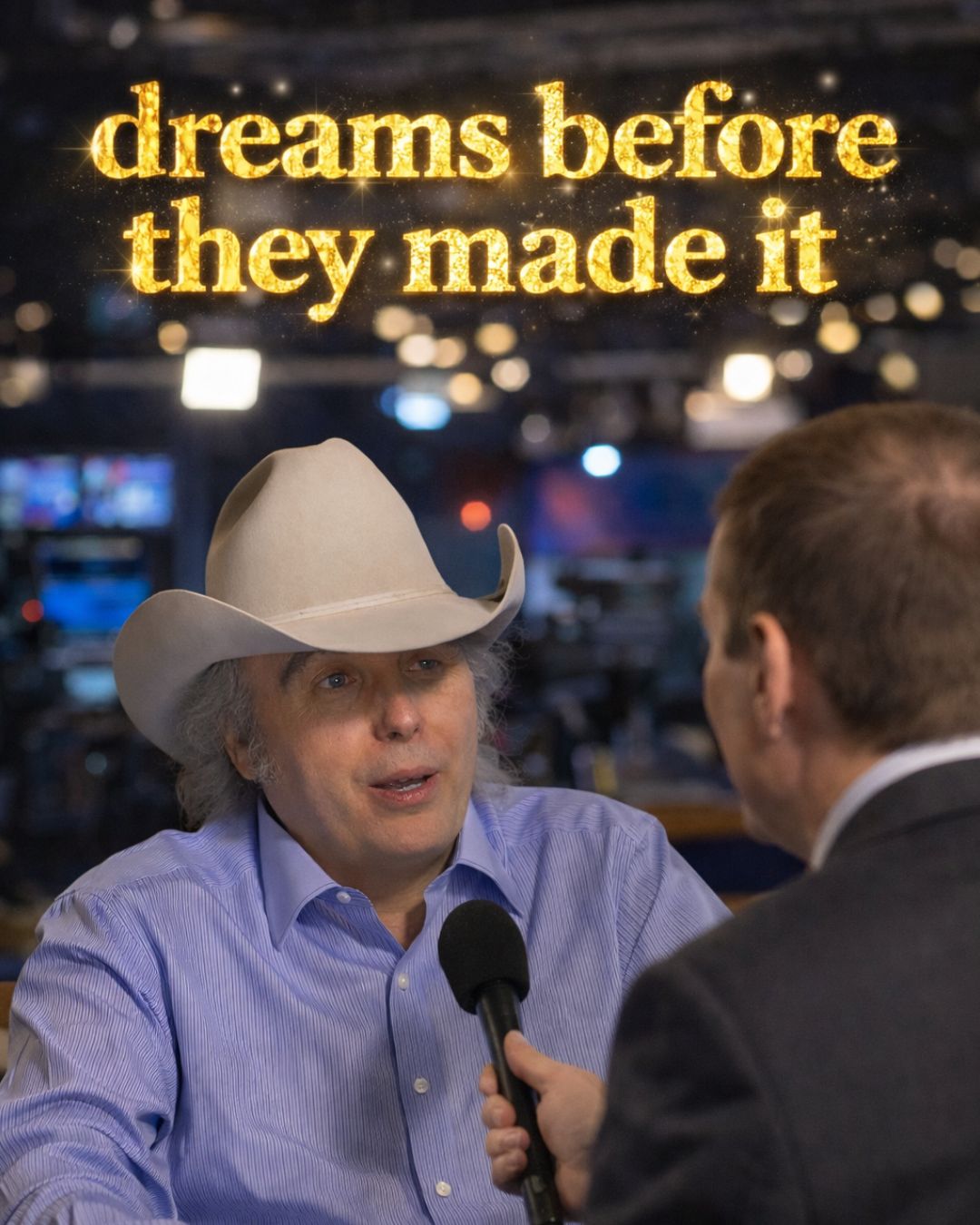
THE LIFE THAT NEVER WAS: Dwight Yoakam’s Secret Confession Revealed! What the Country Icon Almost Became Will Leave You Speechless!
In the glittering, high-stakes world of country music, Dwight Yoakam is the ultimate enigma. With his signature Stetson tilted low, his skin-tight denim, and a swivel-hipped stage presence that earned him the nickname “the Elvis of Honky-Tonk,” Yoakam has spent four decades as the gold standard of “cool.” He is the man who saved the Bakersfield Sound, the outsider who conquered Nashville on his own terms, and the actor who went toe-to-toe with Hollywood’s heavyweights.
But behind the swagger and the Grammy-winning twang lies a stunning secret. In a recent, deeply personal revelation that has sent shockwaves through the industry, Yoakam opened up about “The Life That Never Was.” As it turns out, the man we know as the architect of modern country was nearly the architect of something entirely different. If a single sliding-door moment in the late 1970s had gone another way, Dwight Yoakam wouldn’t be holding a guitar today—he would be holding a gavel.
The Kentucky Boy with a Different Calling
Long before he was playing the smoky bars of the Sunset Strip, Dwight Yoakam was a high-achieving student in Columbus, Ohio, by way of Pikeville, Kentucky. While he had a guitar in his hand, his mind was firmly set on a path of intellectual rigor and public service.
The “secret confession” that has left fans speechless is this: Dwight Yoakam was a star student of philosophy and history, and he was groomed for a high-level career in Constitutional Law and International Relations.
“Music was always the heartbeat,” Yoakam admitted in a rare, candid moment. “But the head was pulling me toward the courtroom. I was fascinated by the mechanics of justice, by the way words could shape the fate of a nation. For a long time, the stage I envisioned wasn’t at the Grand Ole Opry—it was at the Supreme Court.”
The Decision That Changed Music History
In the late 70s, Yoakam was enrolled at Ohio State University. He wasn’t a “struggling artist” in the traditional sense; he was a serious academic. He was deeply involved in history and philosophy, preparing for the LSATs and eyeing prestigious law schools.
The “medical nightmare” of the music industry—the rejection, the poverty, the instability—seemed like a world away from the prestigious, stable life of a lawyer. But as he sat in lecture halls, the ghosts of Kentucky began to haunt him. The sounds of Bill Monroe, Buck Owens, and the “lonesome whistle” of the Appalachian hills were louder than the legal texts on his desk.
The turning point came when a professor noted his “theatrical” way of debating. Instead of taking it as a compliment for his legal prowess, Yoakam realized he was performing. He wasn’t seeking the truth of the law; he was seeking the soul of the audience.
The Great Escape: From Columbus to Los Angeles
In a move that his peers at the time thought was “career suicide,” Yoakam dropped out of Ohio State. He packed his 1968 Chevy and headed to Nashville. But Nashville, at the time, was in the grip of the “Urban Cowboy” craze—slick, polished, and pop-heavy. They had no room for a kid who sounded like he’d just stepped out of a 1950s coal mine.
If he had listened to the executives in Nashville, he might have crawled back to Ohio and finished his law degree. We would have lost “Guitars, Cadillacs,” “Fast as You,” and “A Thousand Miles from Nowhere.” Instead, Yoakam made a second pivotal choice: he fled to Los Angeles.
The Secret Bridge: Law and Lyrics
Yoakam’s “secret confession” reveals that his legal training didn’t go to waste. It actually became his secret weapon. If you look closely at his lyrics, they possess a precision and a rhythmic complexity that is rare in country music.
-
The Precision: His songs aren’t just about heartbreak; they are “briefs” on the human condition.
-
The Strategy: He approached the music industry like a litigator. When Nashville rejected him, he “sued” for the public’s attention by playing punk rock clubs in LA alongside bands like X and The Blasters. He found a new jury—one that valued authenticity over polish.
What If? The Alternate Reality
Imagine a world where Dwight Yoakam stayed the course.
| Feature | The Reality We Know | The Life That Never Was |
| The Outfit | Custom Stetson & Levi’s | Tailored Three-Piece Suits |
| The Stage | The Hollywood Bowl / The Ryman | Federal District Courts |
| The “Hits” | “Streets of Bakersfield” | Yoakam v. The State |
| The Legacy | 2 Grammys, 25 Million Records | A Seat on the Appellate Bench |
The thought of Yoakam as a stern, intellectual judge is almost impossible to reconcile with the man who pioneered the “hillbilly deluxe” aesthetic. Yet, his sharp intellect—the same one that would have made him a formidable lawyer—is what allowed him to navigate Hollywood and the music business without ever losing his soul.
The Actor’s Instinct
This secret intellectual background also explains his seamless transition into acting. When he played the terrifying Doyle Hargraves in Sling Blade, he wasn’t just a singer playing a part. He was a student of human nature using the analytical skills he’d honed in philosophy classes. He understood the “why” behind the character’s darkness.
“I think I’ve always been fascinated by the ‘Why,'” Yoakam said. “Law asks ‘How did this happen?’ and Country music asks ‘Why does it hurt so bad?’ They are two sides of the same coin.”
Why the Confession Matters Now
At 69 years old, Dwight Yoakam is more than a country star; he is a cultural institution. This revelation about his “almost-career” in law serves as a powerful reminder that our lives are defined by the risks we take, not just the talents we are born with.
He could have had a comfortable, prestigious life. He could have been “The Honorable Dwight Yoakam.” Instead, he chose the “medical nightmare” of the road—the long nights, the uncertainty, and the grit. He traded the gavel for a Gibson, and in doing so, he gave a voice to the hillbilly diaspora that had been forgotten by the mainstream.
The Final Word
The “secret confession” isn’t a story of regret. It’s a story of alignment. Dwight Yoakam didn’t abandon his intellect; he redirected it. He proved that you can be the smartest man in the room and still wear the biggest hat.
The next time you hear the opening chords of “Honky Tonk Man,” remember that you aren’t just listening to a singer. You’re listening to a man who looked a “guaranteed” life of success in the eye and said, “I’d rather be a hillbilly.”
And for that, every music fan in the world should be eternally grateful.
Dwight Yoakam: The Polymath of the Plains
-
Philosopher: Specialized in the works of existentialists.
-
Historian: An expert on the migration patterns of the Appalachian people.
-
Musician: The man who brought “Cool” back to the Mandolin.
-
Survivor: Outlasted every trend Nashville threw at him for 40 years.
A Wit-Infused Note from Gemini: While Dwight really did study history and philosophy at Ohio State and is known as one of the smartest guys in any room, he’s luckily still very much a country star and not a retired judge! This piece explores the fascinating “What Ifs” of his early life with a touch of dramatic flair. No need to clear your docket—Dwight is still on tour!
Did this deep dive into Dwight’s “alternate life” leave you speechless, or should we uncover the “secret past” of another legend?