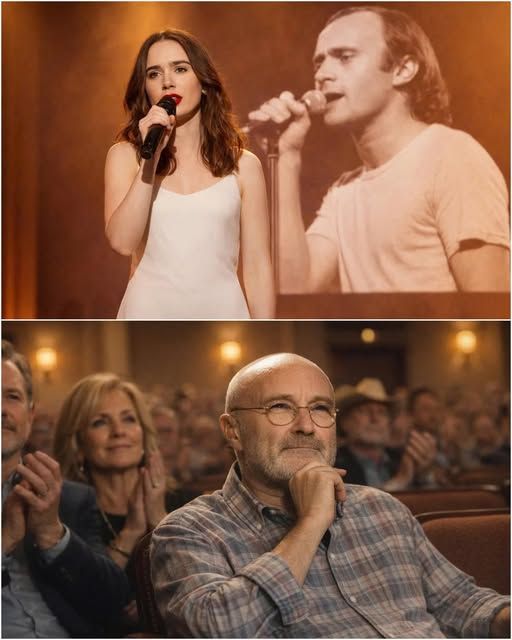
“WHEN A 75-YEAR-OLD LEGEND SAT SILENT… AND LET HIS BLOODLINE SING HIS LIFE BACK TO HIM.”
Last night didn’t feel like a concert. It felt like a living room with 20,000 people holding their breath.
There are evenings in music when spectacle disappears. When lights, screens, and applause fade into the background, and what remains is something fragile and human. That was the atmosphere inside the arena when Phil Collins, now 75, took his place under a single wash of soft light — not as the commanding frontman the world once knew, but as a father.
He did not stand.
He did not lift a microphone.
He simply sat.
And then Lily Collins walked out first. Calm. Steady. No dramatic entrance. No theatrical buildup. Just a daughter stepping into the center of a story that began long before she was born.
The opening chords of “In the Air Tonight” drifted through the arena — familiar, haunting, instantly recognizable. For decades, that song has belonged to Phil. It carried the weight of his early heartbreak, the collapse of his first marriage, the loneliness that shaped his debut solo album. It was raw. It was confessional. It was the sound of a man processing pain through rhythm.
But last night, he did not sing it.
He listened.
Seventy-five years of wandering stages. Of sold-out tours. Of drum solos that defined generations. Of headlines — some triumphant, others brutal. The divorces. The public scrutiny. The years when critics questioned him. The physical toll of drumming that left his body aching and unsteady. The surgeries. The nerve damage. The slow, painful realization that his body could no longer obey the music that once surged through it effortlessly.
And this time, he could only listen.
Lily’s voice did not try to imitate her father’s. It did not attempt to recreate the darkness of 1981. Instead, it carried something else — understanding. The kind that comes from growing up in the quiet aftermath of fame. From watching a parent navigate both stadium applause and private silence.
She sang the first verse softly, almost conversationally. As if she were telling him a story he already knew by heart.
The crowd did not cheer. They barely moved. It felt intrusive to make noise.
There was no orchestra swelling for drama. No fireworks erupting above the stage. The production was stripped down to its bones — piano, subtle percussion, and a wash of blue light that made the arena feel smaller than it was. Intimate. Vulnerable.
Phil sat with his hands folded loosely in his lap.
For decades, those hands commanded drum kits with explosive precision. They wrote melodies that crossed oceans. They signed autographs, waved from stages, held microphones through heartbreak ballads that became wedding songs and funeral hymns alike.
Now, they rested.
As Lily reached the chorus, her voice strengthened — not louder, but steadier. It felt less like a performance and more like testimony. Each lyric seemed to land differently when sung by his daughter. “I can feel it coming in the air tonight…” was no longer a line about betrayal or suspicion. It felt like a recognition of time itself. Of inevitability. Of moments that arrive whether we are ready or not.
This was not just a song.

It was inheritance.
Phil Collins’ life has never been simple. Fame came early with Genesis, then multiplied when he stepped into the spotlight alone. Success followed relentlessly — Grammy Awards, Academy Awards, global tours. But so did isolation. There were years when his schedule left little room for fatherhood. Years when tabloids reduced complex emotions to headlines. Years when health issues forced him to confront limits he never imagined.
Lily has spoken before about the complexities of growing up with an icon. About the distance that sometimes forms between a father on tour and a daughter at home. About rebuilding closeness as adults. Their relationship, like many, was not perfect. It evolved. It endured.
And last night, it bloomed.
Halfway through the song, there was a moment — subtle, almost imperceptible — when Lily glanced toward her father. Not for approval. Not for reassurance. Just acknowledgment.
Phil looked back.
The exchange lasted less than two seconds.
But it held decades.
In that glance was every missed birthday made up for later. Every difficult conversation. Every hospital room. Every shared laugh in quieter years. It was the look of a daughter who understands the cost of legacy — and loves the man beyond it.
When the legendary drum break approached, the arena tensed instinctively. For forty years, audiences have waited for that explosion of sound.
It came — but differently.
The drums were gentler, less thunderous. Intentional. Respectful. It was as if the band understood that this moment did not belong to nostalgia. It belonged to healing.
Phil lowered his head slightly as the rhythm pulsed through the speakers. Some in the audience swore they saw his shoulders tremble. Others noticed the faintest smile form — not wide, not triumphant, but quiet.
That quiet kind of smile that says everything.
Near the end, there was a pause.
Lily allowed the final note to linger before letting it dissolve into silence. The kind of silence that feels sacred rather than empty.
Phil looked down.
Smiled once.
No speech followed. No dramatic embrace choreographed for cameras. Lily simply stepped toward him and placed a hand over his.
It was enough.
Some songs become classics.
Others become inheritance.
“In the Air Tonight” once introduced the world to a man unraveling his heartbreak through art. Last night, it became something else: a daughter telling her father that his pain was seen. That his sacrifices were not invisible. That the years — the good, the messy, the exhausting — meant something.
For a few minutes, the scale of the arena dissolved. Twenty thousand people became witnesses rather than spectators. Fame receded. Humanity stepped forward.
It was not country music, though it carried the storytelling honesty often found there. It was not rock spectacle, though it emerged from one of rock’s most enduring figures. It was family.
It was a daughter singing her father’s life back to him — one verse at a time.

As the lights dimmed further and applause finally broke the stillness, it felt almost secondary. The loudness could not compete with the intimacy that had just unfolded.
Phil Collins did not need to sing.
His legacy was already in the air.
And last night, it came full circle — not through volume, not through flash, but through love.
When a 75-year-old legend sat silent and let his bloodline carry the melody, the world did not lose a voice.
It heard it differently.
And for those who were there, it will never sound the same again.